I've been writing code in many different flavours for over 20 years. Everything from VBA, to Java, to Haskell. I wanted to get back into using a functional language, and Clojure had instant appeal. I already owned a book but after reading the first chapter, I thought I'd try something different: can AI actually teach me, rather than just doing the work for me? No Vibe Coding, no 'just tell me the answer', just a tutor to help me learn, the way I want to learn.
This post covers how I set up Claude Code as my tutor, what worked, what didn't, and my recommendations if you want to try something similar.
I have a large collection of event tickets (concerts, sports events etc.) and I wanted to build a 3-tier web app as an inventory of them. The app would have a SQLite database, and use Clojure for the API & front-end.
Before a single line of Clojure was written, I defined three things:
CLAUDE.md file.data_model.md file.openapi.yaml.As you can see, this wasn't about just getting AI to do it for me. I devised the exact plan for the application I wanted to build, and I wanted the AI to help me learn how to implement it in Clojure. I defined how the application was to be structured and designed, leaving Claude Code to simply help me implement it using Clojure, and to explain the concepts I needed to understand along the way.
A CLAUDE.md file, which Claude Code reads at the start of every session. It sets out:
Below is a snippet of the instructions, which I wrote before a single line of Clojure was written.
## Core Principles

### Test-Driven Development (TDD)

- **Always write tests first** before implementation
- Red → Green → Refactor cycle for every feature
- No code lands without corresponding tests

### Learning Through Building

- Explain Clojure concepts when introducing them
- Developer must write code, not just have Claude write it all.
  Consider when 'try and verify' should be used for new concepts
  and to cement learning.
- Include all explanations, lessons etc. in `/docs/training.md`
  so I can refer back to them later
There were three rules everything else relied on:
💡Tip: You can download my full instructions here.
How I wanted the SQLite database to be structured, and how the tables related to each other.
### Events

- id [auto] (Primary Key)
- name [string(150)]
- date [date] (Optional)
- unknownDate [boolean] (if date is unknown, default False)
- notes [string(1000)] (Optional)
- venueId [integer] (Foreign Key to `venue.id`)
Plus how they relate:
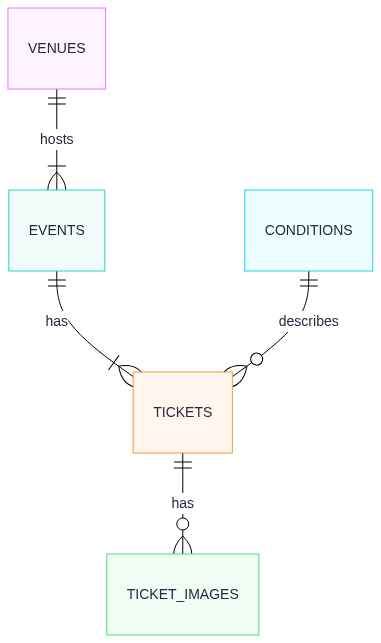
erDiagram
    VENUES ||--|{ EVENTS : hosts
    EVENTS ||--|{ TICKETS : has
    CONDITIONS ||--o{ TICKETS : describes
    TICKETS ||--o{ TICKET_IMAGES : has
From that, I also wrote an OpenAPI spec for the endpoints. None of it is complicated, for an experienced developer, but it meant I used the AI solely for learning, and I was still in control of the development process & structure.
The approach I valued most is what I've been calling 'fill in the gaps'.
Rather than handing me a finished method, Claude would explain the concept, then give me a skeleton with some parts left blank. My task was then to fill in the blanks. If I got stuck, I would ask Claude for help. Everything I asked was logged in the docs/training.md file so I could refer back to it later.
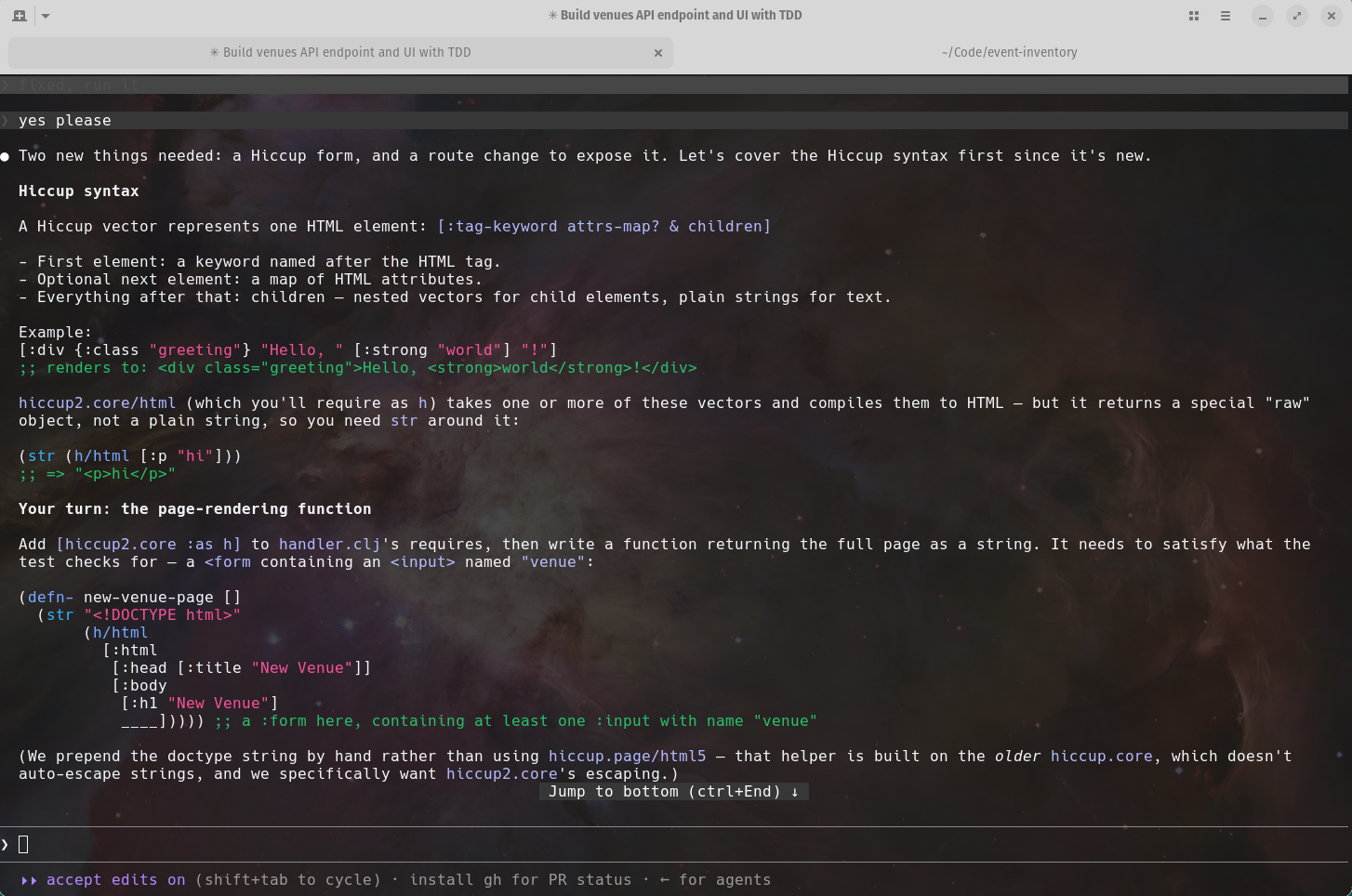
Why does this work so well? This is the difference between reading an example and completing an exercise yourself. To fill in the blanks, I had to read and understand the code around it. Copying blocks of finished code teaches you very little; filling the gap makes you think (hard at times). This wasn't just copy and paste (I tried to avoid CTRL+C, CTRL+V as much as possible, and instead would type what I saw).
💡Tip: You don't need a special tool or instructions for this. Just ask: "Don't write it for me. Give me a skeleton with blanks and explain what goes in each."
It didn't always go to plan. Early on, while creating some of the database layer, Claude wrote the SQL file, the code that loads it and the tests, all without my input. Its reasoning was that it was 'just boilerplate'.
My response:
you have just created code without me. You're meant to be teaching me.
Claude acknowledged the mistake and saved the correction to its memory so it would apply in future sessions. From then on Claude largely stuck to the plan.
The lesson for me was that AI defaults to doing the work for you, even when you've written down that you don't want it to. You have to keep on top of it and notice when AI isn't behaving as expected.
I did make exceptions, however: wiring up a logging library wasn't something I wanted to learn that day, so I let Claude do it. I was OK with this as I made that decision and I was still achieving my goal of learning Clojure.
Every explanation went into docs/training.md, which is now over 800 lines of notes written about my code, questions & mistakes. For example (as taken from the training log, generated by Claude):
hickory instead of substrings## 2026-07-30 — Testing server-rendered HTML with `hickory` instead of substrings
The first version of `get-venues-renders-page` asserted on raw markup with
`str/includes?` and a regex counting `<li` occurrences. That style of
assertion has a real blind spot: it can't tell *where* text landed. This
came up for real — an earlier bug had venue names rendered as HTML
*attributes* instead of visible text (`<li id="1" venue="Anfield">`, empty
tag body), and the substring-based test still passed, because `<li` still
appeared twice in the markup. The test was checking the shape of the soup,
not what a browser would actually show a user.The most valuable exchanges weren't 'how do I do X?'. Early on, a test called venue/create-venue!, yet there was no defn for it anywhere. I didn't understand where it came from. It turns out HugSQL reads a comment in the SQL file (-- :name create-venue! :<! :1) and creates the function when this line loads:
(hugsql/def-db-fns "sql/venue.sql"
  {:adapter (next-adapter/hugsql-adapter-next-jdbc)})
I also asked whether the :venue parameter was safe from SQL injection. Claude opened HugSQL's source and showed me the one function that swaps :venue for a ? placeholder. Claude didn't just tell me the answer, it showed me.
In my TDD post I said that I struggle to practise 'full' TDD in languages I don't know well. With an AI tutor on hand to explain the test framework, it was much easier. I stayed test-first throughout.
In two days I had two working API endpoints and a working UI, with validation (for a single page), centralised error handling and styling, all test-first. More importantly, I could understand and explain the code, because I wrote it.
metosin/reitit-muuntaja, that simply doesn't exist (the right one was reitit-middleware).-- inside an XML comment, which isn't allowed, and crashed every test run before any Clojure loaded.We had passing tests, yet the page didn't render. My validation errors returned the right HTML and status code, and every test passed. Yet nothing appeared on screen: htmx quietly discards error responses unless you tell it otherwise. My tests never ran a browser, so they couldn't see it. I only found it by manually testing. Claude didn't spot this (and we've not yet implemented proper browser testing).
Claude keeps notes between sessions, but they aren't always current. When I came back after a break and asked 'where did we get to?', its notes said nothing had been committed since the first day; yet there had been a dozen commits since then. It corrected itself by checking git, but only because I asked. Trust but verify: don't assume the AI's memory is correct.
If you want to learn a new language with an AI tutor, I recommend:
I was frankly astonished at how well Claude Code worked as a tutor, though it needed my experienced eye to keep it on track, and it will do the work for you if you let it. Set the rules first, design the thing yourself and have the AI be your guide. Can I say I now 'know' Clojure? Not really, but I'm definitely more knowledgeable. Let's see where I am when I've completed the build.
Next time you reach for an AI assistant to build something, because you don't know how to, try asking it not to write the code. You may be surprised how much more enjoyable & rewarding that is.